Commercial real estate is one of the most reliable ways to build long-term wealth and earn regular rental income. But once you decide to invest, the next question is harder: should you buy a shop or an office?
Both can deliver strong returns, but they work very differently. A retail property depends on visibility, customer footfall and the surrounding market. An office property depends on business activity, connectivity and demand from corporate tenants.
At Nest Square Consultant, this is one of the most common questions we hear from investors in Andheri and across Mumbai. So in this guide, we’ll compare retail space vs office space investment in simple terms. We’ll cover rental yield, risk, tenant stability and exit potential, so you can decide which one fits your goals.
Is Commercial Property a Good Investment in 2026?
Demand on both sides of the market has stayed strong. On the retail side, CBRE reported that leasing by retail firms across India’s top cities reached a record of about 8.9 million sq. ft. in 2025, with experiential flagships, Gen Z-focused formats and the offline expansion of direct-to-consumer brands driving much of that momentum.
The office market has been just as active. The final quarter of 2025 saw the highest-ever quarterly office leasing, at 20.6 million sq. ft. And that momentum carried into this year: Colliers reported that office leasing across India’s top seven cities rose 7% year-on-year to 54.4 million sq ft between January and September 2026, led by GCCs, technology firms and flexible workspace operators.
However, national numbers don’t tell the full story. In the July–September 2026 quarter, office leasing in Mumbai fell 20% to 2.4 million sq ft, down from 3 million sq ft a year earlier. That’s exactly why micro-market research matters more than headlines. A property in Andheri East near the metro can behave very differently from one a few kilometres away.
What Is Retail Space Investment?
Retail space includes shops, high-street stores, showrooms and retail units in malls or mixed-use developments. Its biggest strength is its direct connection with customers. A well-located shop with good frontage and steady footfall attracts tenants such as cafés, salons, clinics, pharmacies, fashion stores and restaurants.
But in retail, location is everything. In Mumbai, a shop on a busy stretch of Link Road or in Lokhandwala Market can perform completely differently from a similar-sized shop on a quiet internal road just a short walk away.
Retail investment works well when you have:
- Strong visibility and road frontage
- A dense residential or office catchment nearby
- Parking or easy pedestrian access
- A rent level that local businesses can actually sustain
What Is Office Space Investment?
Office space investment means buying a commercial unit and leasing it to companies, startups, professionals or corporate tenants. Office demand depends on connectivity, proximity to business hubs, public transport, building quality and the surrounding business ecosystem.
In Mumbai, business districts such as Andheri East (Chakala, Marol, MIDC and the Metro Line 1 corridor), BKC and Lower Parel attract steady office demand. Grade A office space in well-maintained buildings typically attracts better tenants and longer leases.
This is why many investors see offices as a source of relatively predictable rental income. A good corporate tenant may stay for several years, especially if the lease includes a lock-in period. That reduces the time and cost of finding new tenants.
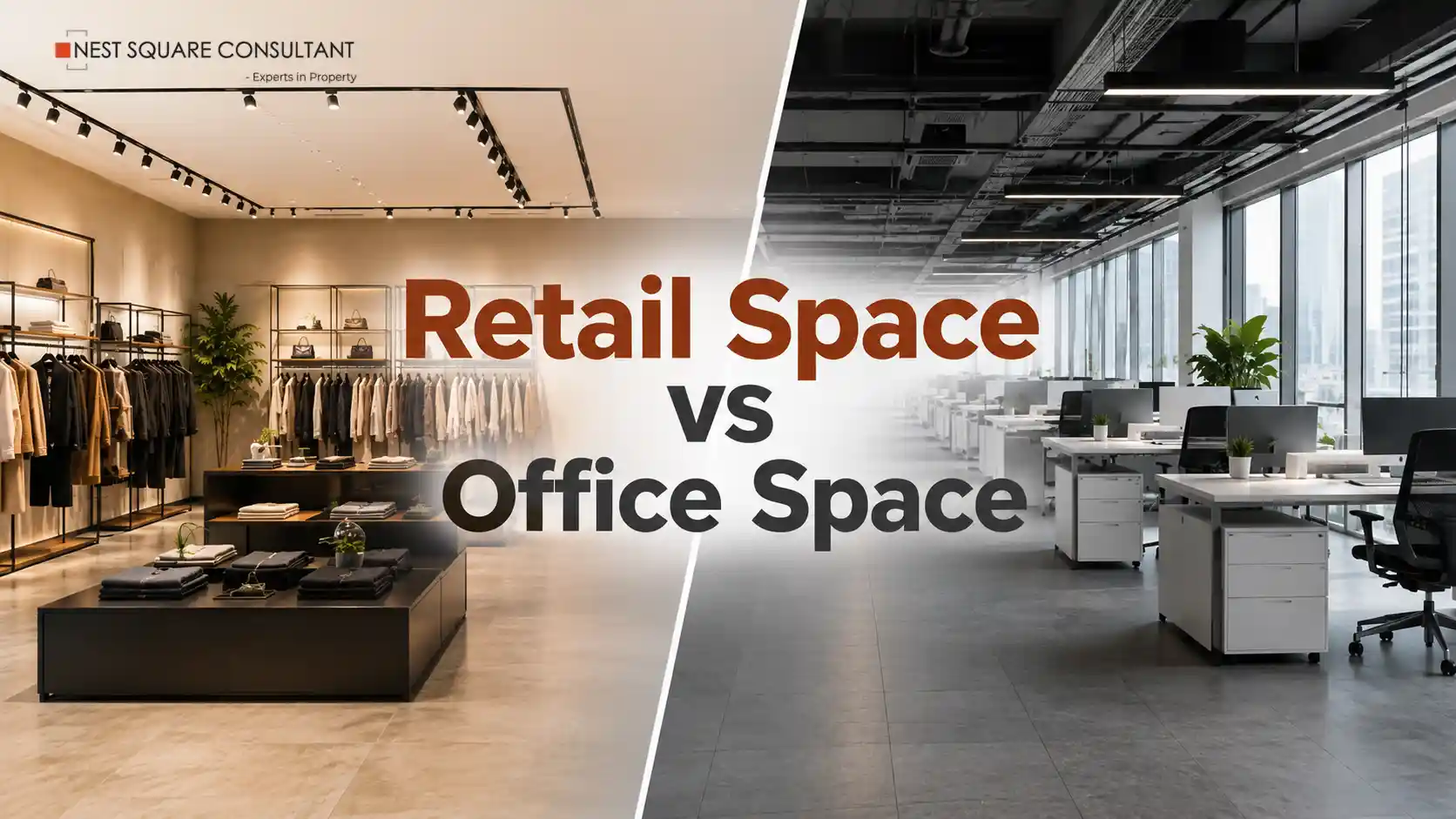
Retail Space vs Office Space: Quick Comparison
| Factor | Retail Space | Office Space |
|---|---|---|
| Main demand driver | Customer footfall and visibility | Business activity and connectivity |
| Typical tenants | Shops, cafés, salons, clinics, restaurants | Companies, startups, professionals, service firms |
| Location priority | High street, busy markets, malls | Business hubs, metro corridors, commercial districts |
| Tenant turnover | Usually higher | Generally lower |
| Lease tenure | Often shorter | Often longer, with lock-in periods |
| Management effort | More active management | Comparatively easier once leased |
| Sensitivity to market | Consumer spending and local competition | Corporate hiring and workplace trends |
| Best suited for | Investors seeking location-driven upside | Investors seeking stable rental income |
How to Calculate Rental Yield on Commercial Property
Before comparing retail and office options, you need to know how to measure returns properly. The basic formula is:
Gross Rental Yield = (Annual Rent ÷ Total Investment Cost) × 100
Example (for illustration only): You buy an office in Andheri East for a total cost of ₹1.5 crore, including stamp duty, registration and other charges, and lease it at ₹90,000 per month. Your annual rent is ₹10.8 lakh. Your gross rental yield is ₹10.8 lakh ÷ ₹1.5 crore × 100 = 7.2%.
But gross yield isn’t what you actually earn. To find your net rental yield, subtract maintenance charges, property tax, insurance, brokerage and an allowance for vacancy periods. A property advertising an “8% yield” can easily deliver much less once these costs are counted.
This is where Nest Square Consultant helps investors most. We compare advertised returns with realistic, cost-adjusted numbers before you commit.
Retail vs Office: Which Has Better ROI?
There’s no universal answer. A retail property in a high-demand location with a reliable tenant can deliver excellent rental income and capital appreciation. However, prime retail usually comes with a high entry price, and a vacant shop can stay empty longer if the location loses footfall.
An office property can offer a more predictable income stream, especially when leased to an established business. But investors still need to consider maintenance costs, vacancy risk and changing workplace trends, such as hybrid working and the growth of flexible workspaces.
So instead of asking, “Which property gives the highest return?”, ask, “Which property offers the best risk-adjusted return for my budget and goals?” That’s a far more useful way to evaluate commercial property investment in Mumbai.
Which Commercial Space Is Better for First-Time Investors?
For most first-time investors, office space is easier to manage, particularly a pre-leased commercial property with a credible tenant in an established business area. You get rental income from day one, and there’s less uncertainty about finding a tenant.
Retail suits investors who understand local consumer behaviour and are comfortable judging frontage, footfall and tenant suitability.
If you’re unsure, professional guidance can save you from expensive mistakes. The team at Nest Square Consultant helps investors compare purchase price, expected rent, location, tenant profile and future potential based on real market conditions, not just advertised returns.
5 Factors to Check Before Buying Commercial Property
Whether you choose retail or office, check these five factors before you decide:
- Location. Study accessibility, upcoming infrastructure (metro lines, road projects), surrounding developments and competing properties.
- Tenant demand. Which businesses are likely to rent this space, and is there genuine demand for that category in this location?
- Total investment cost. Look beyond the purchase price. Factor in stamp duty, registration, GST (where applicable), maintenance, fit-out costs, brokerage and possible vacancy periods.
- Rental potential. Compare expected rent with similar properties nearby. A high advertised rent doesn’t guarantee you’ll achieve it.
- Exit potential. Consider who might buy the property from you later. Properties with a wider buyer pool are easier to sell.
Also verify the legal documents, including the title, Occupancy Certificate (OC), and the carpet area versus the built-up area, before paying any token amount.
Retail vs Office: Which One Should You Choose?
Choose retail space if:
- You’re targeting a high-footfall, high-street location
- You understand the local consumer market
- You’re comfortable with higher tenant turnover
- You want to benefit from strong demand for visible commercial locations
Choose office space if:
- You prioritise stable, long-term rental income
- You’re investing in a well-connected business district
- You prefer corporate or business tenants with longer leases
- You’re comfortable with a potentially higher initial investment
Conclusion
Both retail and office spaces can play a valuable role in a commercial property portfolio. The better choice isn’t decided by property type alone. Location, tenant demand, pricing and long-term market potential determine how an investment actually performs.
If you’re evaluating commercial property investment in Mumbai, work with a team that knows the local micro-markets and can compare options objectively. Nest Square Consultant helps investors across Andheri and Mumbai shortlist, evaluate and close the right commercial property, whether that’s a high-street shop, a pre-leased office or an office space in Andheri East.
Frequently Asked Questions
1. Which gives higher rental income, retail or office space?
Retail spaces in prime, high-footfall locations can command strong rents, while office spaces tend to offer more stable income from business tenants. Actual returns depend on location, property quality, purchase price and tenant demand, so always compare net rental yield, not just the advertised rent.
2. What is a good rental yield for commercial property in Mumbai?
Commercial property generally offers higher rental yields than residential property, but yields vary widely by micro-market, property type and tenant quality. Calculate your net yield after maintenance, taxes and vacancy allowances. Nest Square Consultant can help you benchmark yields for specific properties.
3. What location is best for retail property investment?
The best retail locations have strong footfall, visibility, accessibility, parking and a suitable customer catchment. In Mumbai, established high streets, busy market areas and well-performing mixed-use developments usually offer the best opportunities.
4. What should I check before buying a commercial property?
Check the location, legal documents (title and OC), total acquisition cost, rental potential, tenant demand, building quality, maintenance expenses, vacancy risk and resale potential before investing.
5. Can office property appreciate in value?
Yes. Office properties can appreciate when demand rises because of infrastructure improvements, business growth, limited quality supply and rental growth. However, capital appreciation varies significantly by location and individual property.
6. Is a pre-leased commercial property better for investment?
A pre-leased property gives you immediate rental income and removes the uncertainty of finding a tenant. Before buying, carefully review the lease terms, tenant quality, rent escalation clause, lock-in period and remaining lease tenure.