
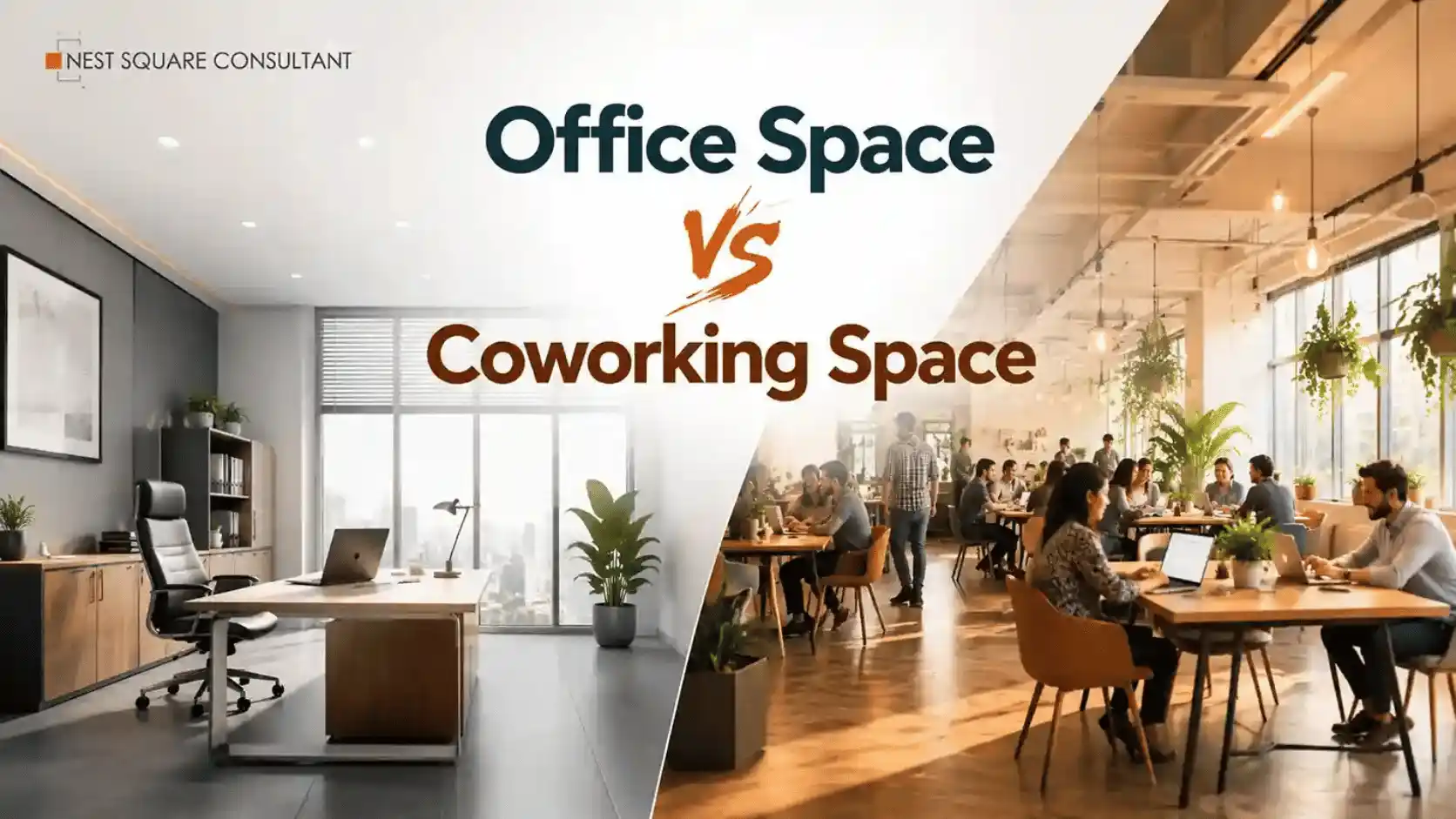
Choosing a workspace is more than deciding where your team will sit every day. Your office affects your monthly expenses, employee experience, client meetings, company image, and even how easily you can grow.
A traditional office offers privacy, control, and a dedicated environment; coworking spaces provide flexibility, convenience, and opportunities to connect with other professionals. But which option suits your business best?
At Nest Square Consultant, we help businesses explore commercial property options based on their specific requirements, whether they are looking for a dedicated office or a flexible workspace. The right choice depends on factors such as your team size, budget, location, and plans.
Let’s dive into the blog to understand the key differences between office space and coworking space and find out which option could be the better fit for your business.
What Is a Coworking Space?
A coworking space is a shared, professionally managed workspace used by people and businesses from different companies. It usually offers hot desks, dedicated desks, private cabins, meeting rooms, and common areas.
Its main benefit is convenience, as businesses can start working immediately without setting up an office. It is ideal for startups, freelancers, small teams, and hybrid work setups, with flexible plans that can scale as needed.
Benefits of a Coworking Space
- Flexible workspace options
- Lower setup requirements
- Ready-to-use office facilities
- Networking opportunities
- Professional environment for meetings
- Easier expansion or downsizing
- Less responsibility for everyday office management
What Is a Traditional Office Space?
A traditional office space is a dedicated workplace rented by one business, offering full control over layout, furniture, branding, and setup.
It suits established teams that need privacy and consistency, with options to customize cabins, meeting rooms, and interiors. However, it also comes with added responsibilities like furnishing, maintenance, utilities, and internet.
Benefits of a Traditional Office
- Complete control over the workspace
- Better privacy for employees and clients
- Freedom to customise interiors
- Dedicated meeting and conference areas
- Stronger opportunity for brand visibility
- A permanent home for your team
Office Space vs Coworking Space: Key Differences
While both options provide a professional place to work, the experience can be quite different.
| Factor | Coworking Space | Traditional Office |
| Privacy | Varies by workspace | High |
| Flexibility | Usually higher | Usually lower |
| Customisation | Limited | Extensive |
| Setup | Generally ready to use | Requires investment and planning |
| Networking | Stronger opportunities | Limited |
| Branding | Usually limited | Full control |
| Management | Usually managed by provider | Mostly your responsibility |
| Scalability | Generally easier to adjust | May require a new space |
| Best suited for | Startups, SMEs and flexible teams | Established and growing teams |
The comparison is not about finding one universally better option. It is about finding the workspace that matches your business priorities.
Factors to Consider When Choosing the Right Workspace
Choosing between a traditional office and a coworking space becomes easier when you look beyond the monthly rent. The right workspace should support your team, fit your budget, and work well with your long-term business plans.
1. Location and Accessibility
Location matters for both employees and clients. Consider public transport, road connectivity, parking, nearby amenities and how convenient the area is for your team and visitors. For businesses in Mumbai, a well-connected commercial location can make a significant difference.
2. Budget and Overall Costs
Don’t look at rent alone. Consider furnishing, maintenance, electricity, internet, housekeeping, security and other expenses. Coworking spaces often include several facilities, while a traditional office may require more upfront investment.
3. Team Size and Future Growth
Think about your current team as well as your expected growth. If your team is expanding quickly, choose a workspace that can accommodate additional employees without forcing you to relocate too soon.
4. Privacy Requirements
Consider how much privacy your business needs. If your team regularly handles confidential information or holds private client meetings, a dedicated office or private coworking cabin may be more suitable than an open shared workspace.
5. Scope for Customisation
If you want your workspace to reflect your brand, a traditional office generally gives you more freedom to customise the interiors, furniture, signage and layout according to your requirements.
Before making a decision, it is worth comparing these factors carefully rather than choosing a workspace based only on price. Nest Square Consultant can help businesses evaluate commercial property options based on their location, budget, team size and specific workspace requirements.
Who Should Choose a Coworking Office?
A coworking office can be a practical choice for businesses that value flexibility, convenience and a ready-to-use professional environment. It is especially suitable for:
1. Startups and New Businesses
Startups often need to manage expenses carefully while building their team. A coworking office provides a professional workplace without the need to invest heavily in interiors, furniture and other setup requirements.
2. Freelancers and Independent Professionals
Freelancers who want to move away from working from home can benefit from a structured and professional environment. Coworking spaces also provide opportunities to meet other professionals and build useful business connections.
3. Small and Growing Teams
If your team size is changing frequently, a flexible coworking arrangement can make it easier to add or reduce workspace as your business grows.
4. Businesses With Hybrid Teams
Companies where employees work partly from home and partly from the office may not need a large permanent workplace. Coworking spaces can offer a more flexible solution based on actual office usage.
5. Businesses Entering a New Location
If you’re expanding into a new area, renting a coworking office can provide a professional base without immediately committing to a long-term commercial property.
Who Should Choose a Traditional Office Space?
A traditional office space can be a better fit for businesses that want greater privacy, control and a workspace designed around their specific needs. It is particularly suitable for:
1. Established Businesses
Companies with a stable team and predictable workspace requirements may benefit from having a dedicated office. It provides consistency and gives employees a permanent place to work and collaborate.
2. Businesses That Need Privacy
If your business regularly handles confidential documents, sensitive client information or private discussions, a dedicated office provides greater control over the working environment.
3. Client-Facing Businesses
Businesses that frequently meet clients at their workplace may prefer a traditional office. You can create a professional reception area, meeting rooms and interiors that reflect your company’s identity.
4. Companies That Want Customisation
A dedicated office gives you more freedom to decide the layout, furniture, branding, cabins and work areas. This can be useful when your workspace needs to match your company’s culture or specific operations.
5. Businesses Planning for Long-Term Stability
If you expect your team and workspace requirements to remain relatively stable, a traditional office can provide a consistent environment without the need to frequently change locations or arrangements.
If you’re looking for a fully furnished office for rent in Andheri or a dedicated commercial workspace, Nest Square Consultant can help you explore options based on your business requirements, budget and preferred location.
Conclusion
Your workspace is more than just a place where your team comes to work, it can shape productivity, client experiences and the way your business grows. Whether you choose the flexibility of a coworking space or the privacy and control of a traditional office, the right choice should fit the way your business operates today while leaving room for tomorrow.
There’s no need to follow a one-size-fits-all approach. Take a closer look at your team size, budget, location, privacy needs and plans before making a decision. After all, the best workspace is not simply the one that looks good on paper, it’s the one that works well for your business.
At Nest Square Consultant, we understand that finding the right commercial space can take time and careful consideration. From office spaces to coworking spaces, we help businesses explore options that align with their practical needs and growth plans.
The right space can be the beginning of your next big move. Choose a workspace that gives your business room to work, connect and grow.
FAQs
1. Is owning a coworking space profitable?
Yes, owning a coworking space can be profitable with consistent demand, strong occupancy, and effective cost management. Location, pricing, membership plans, amenities and operating expenses strongly influence profitability, especially in competitive commercial markets.
2. Which is more cost-effective: coworking space or commercial office?
Coworking spaces are often more cost-effective for startups and small teams because many operational expenses are bundled into one fee. A commercial office may offer better long-term value for established businesses needing dedicated space and customisation.
3. Is location important when choosing office space?
Yes. Location can influence employee convenience, client accessibility, business visibility and operating costs. For Mumbai businesses, comparing commercial locations based on connectivity, surrounding infrastructure and business requirements can help make a practical decision.
4. Are coworking spaces a good investment?
Coworking spaces can be a good investment when located in areas with strong business demand and managed efficiently. Success depends on occupancy rates, rental costs, membership pricing, location, facilities and the ability to retain members.
5. What amenities are typically included in a coworking space?
Typical coworking amenities include high-speed internet, workstations, meeting rooms, air conditioning, reception services, pantry areas, housekeeping and security. Some spaces may also provide printing facilities, private cabins, parking, lounges and access to networking events.